Expertise
Preserved green wall for a professional office
A preserved green wall for a professional office: placement, format and finishes, illustrated by three legal practices.
A visitor enters a professional practice to entrust a file, seek advice or prepare an important decision. The interior should help them find reception, move without hesitation and understand whose office they have entered. A preserved green wall can shape that first impression when it is designed for the room rather than added as a standard picture. The right format depends on the available wall, the viewing distance, the furniture and the space reserved for practical information.
In a notary office or law firm, discretion matters as much as visual presence. Preserved plants bring natural material indoors without an irrigation network or dedicated grow lights. They do not eliminate normal care of the premises: the work should be protected from repeated contact, water splashes and heat. This guide explains how to choose a location, prepare a brief and assess the result through three VG.TAL3Design projects.
What role should a plant wall play in a professional office?
Before choosing mosses or a shape, ask a simple question: what should a person see when they come through the door? In some rooms, plants frame the reception desk. In others, they mark a passage or give presence to a meeting room. Their role changes when visitors see them head on, in motion or while seated. A composition that looks beautiful close up can become confusing from the entrance.
The installation should not hide wayfinding, obstruct a door or narrow a passage. Look at what is already in the room: stone, wood, furniture colours, lighting and any emblem of the practice. The aim is a coherent whole. If expressing the brand is the main objective, our plant logo guide covers that decision in depth. Here, the starting point is how the premises are used.
Choose a format that fits the available wall
A continuous mural for a clear surface
A clear wall visible from a reasonable distance can carry a continuous mural. It becomes a visual landmark in the room. First check its actual boundaries: skirting boards, sockets, switches, returns and the part that furniture will conceal. A photograph from the entrance often tells you more than an isolated measurement. It reveals whether people will perceive the wall as one surface or in fragments.
A triptych to give the wall rhythm
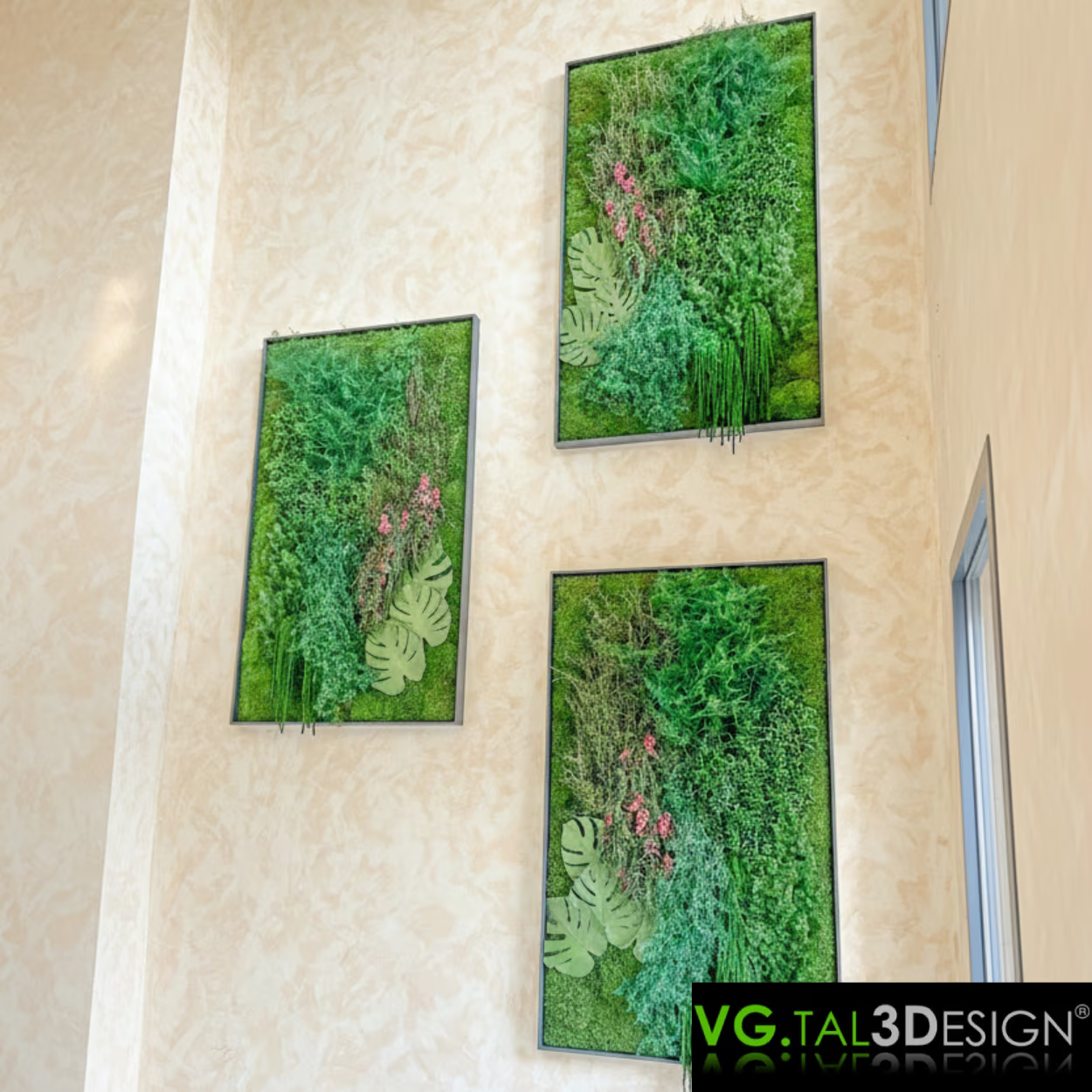
Several panels can work with a tall wall or a surface that need not be covered from edge to edge. The gaps between panels become part of the composition. At the Lyon law firm, three preserved plant pictures are arranged on a light wall; their placement creates a vertical rhythm and leaves visible space around them. This is not a universal answer. Draw the entire composition to the scale of the room and check the view on arrival.
A circular piece for a distinct identity
A circular or custom cut shape can suit a wall where a graphic emblem must connect decoration with identity. In Le Havre, the notary office mural combines a plant circle with a central white emblem. Its contrast makes the sign visible against the green. Such a piece calls for checks on the supplied artwork, proportions, fine lines and the lighting that actually exists in the room.
Prepare the project before production
An initial brief needs more than the width of a wall. A measured plan, photographs of the premises, ceiling height and views from the entrance all help select the format. State the type of support, the equipment that must remain accessible and suitable installation dates. If the office remains open during fitting, discuss visitor circulation and the installation team’s access in advance.
Study viewpoints as well as dimensions
A plant wall can occupy an attractive area yet sit in the wrong place. Take photographs from two or three points where a visitor pauses: entrance, reception, waiting area or meeting room. Mark the visible field, distance and obstacles in each view. A panel mounted too low may vanish behind furniture; a small detail can disappear from the far end of the room. Reading this route informs height and depth.
Check the support and the finishes
The weight, fixings and condition of the wall have to be confirmed with the installers for the actual project. A lined wall, partition or uneven surface should never be judged by assumption. Planning sockets and lighting also avoids cutting a finished composition later. Edges, frames and joints should sit comfortably with the room’s other materials. Our support preparation guide looks at these checks in more detail.
Choose materials for the right viewing distance
Mosses provide a textured base; foliage and relief can add expression. In a small room, too much variation may distract from reception or the emblem. On a long wall, transitions can prevent the work from looking uniform. Approve a palette and direction before production. The guide to mosses and foliage helps frame the material choice.
Three projects, three different responses
These are not three versions of one wall. They show how form follows the room’s purpose. The photographs below document the actual projects; they do not demonstrate acoustic performance or health effects. They help you read the relationship between plants, wall, emblem and circulation.

Le Havre notary office: a circular plant composition carrying the practice’s identity.
View projectIn Le Havre, the notary office’s plant circle draws the eye to a white emblem. This can suit an identity that should be noticed on arrival, provided the mark remains readable from the usual viewing distance. It also raises a key design decision: how much visual space belongs to the plants and how much to the practice’s name?
Lyon law firm: a triptych that gives rhythm to a tall wall.
View projectIn Lyon, a law firm chose three separate panels. The photograph shows their scale on the wall and the gaps between frames. The project illustrates how to work with height without turning the whole surface into a green wall. View the entire group before deciding the dimensions of an individual panel.
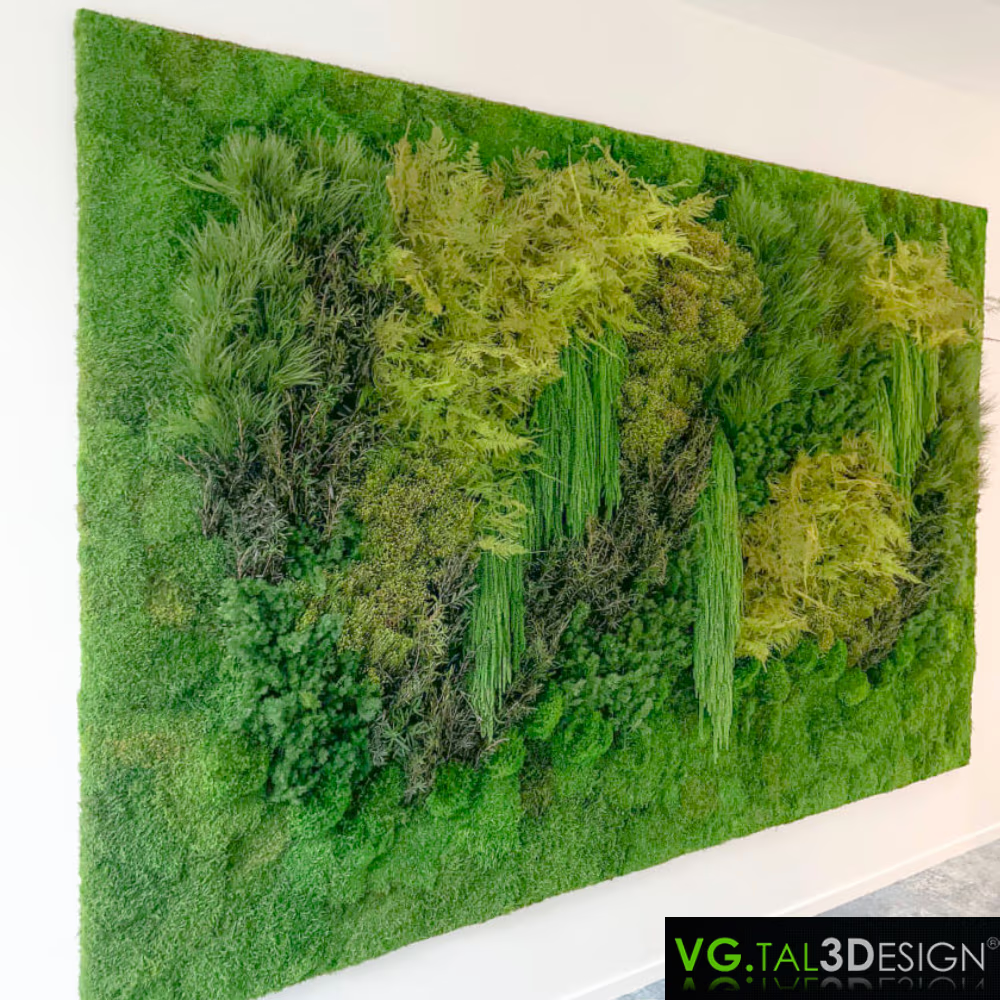
Paris law firm: a continuous mural of mosses and foliage.
View projectIn Paris, a rectangular mural covers a continuous area. Its photograph shows a moss base and layered foliage in several greens. It lets you assess the detail and the overall effect. In a professional office, this approach needs a sufficiently clear wall and a viewing distance consistent with the entrance or waiting area.
Compare formats before requesting a proposal
The table summarises situations in which each format can work. It does not replace an examination of the room. More than one approach may be possible; viewpoints, support and the intended purpose decide between them.
| Format | Suitable setting | Check before making |
|---|---|---|
| Continuous mural | Clear wall visible from the entrance | Viewing distance and corner access |
| Triptych | Tall wall or a surface with constraints | Spacing between panels |
| Emblem piece | Identity visible at reception | Legibility from a distance |
A preserved green wall is an option when the practice wants plant material without watering or grow lights. If the brief calls for living plants, light, water and maintenance requirements are different and should be studied separately. The preserved green wall range presents this option, while the indoor green wall page helps place it among other solutions.
What to send the workshop
Send an overall photograph of the room, a view from the entrance and a close view of the support. Add known dimensions, doors, sockets and fixed furniture. If a logo is part of the composition, provide usable vector artwork and brand guidelines. State when installers can access the premises and who can approve decisions.
Ask for a proposal that shows the format in the room, not merely a sample of plants. Check space for everyday use: floor cleaning, circulation, equipment access, personal safety and cleaning of neighbouring surfaces. Preserved plants are not handled like potted plants. Keep the work out of spots where visitors are likely to touch or splash it regularly.
Frequently asked questions
Does a preserved green wall need daylight?
Not for preservation: these plants no longer grow. Ambient lighting may nevertheless help show texture and colour. Choose it for the room without placing the work against a heat source.
Can the practice’s logo be included?
Yes, if the artwork suits the chosen format. Check fine lines, contrast and legibility from the entrance. The Le Havre notary office offers one example, not a template to copy.
Must the whole wall be covered?
No. A triptych, a partial mural or a circular piece may respect the wall and furniture better. The choice depends on viewpoints, available height and the role of the work at reception.
Does preserved greenery need watering?
No. It is not watered or trimmed like living plants. Protect it from splashes, repeated handling and conditions that could alter its appearance.
What should be provided for a proposal?
Photographs of the main viewpoints, dimensions, support type, a floor plan if available, furniture positions and access constraints. Include graphic files if the work incorporates a logo.
Design a coherent welcome
A good project begins with an understanding of the room and its use. A notary office, law firm and consultation space may need different formats. If you are planning an interior, send your views and constraints through our contact page. The workshop can then study a custom composition suited to the wall and the practice’s identity.
Ready to start your project?
Whether you are a business or a private client, our team is ready to support you in designing your custom plant installation.
Get a free quotePersonalised response within 48h · No-obligation quote